
Yes King
The Servant King Who Subverts All Our Ideas of Power

The essay below is adapted from my Palm Sunday sermon preached at Christ Episcopal Church.
Recently I read someone who wrote that if you read the bible’s account of Israel’s kings, most of them come off looking like fools. And that, they said, seems to be the point. I’ve said it before, but God doesn’t seem to be a fan of kings. However well a dynasty may start, however well-intentioned a king might be, centralized authority in human hands is bound to end up in chaos. So it is that all the kings of Israel and Judah, from Ahab to Zedekiah end up coming off badly. Even David, who is the model king, the one after God’s own heart, ends his reign in tragedy.
We may think all of this doesn’t apply to us. We are, at least ostensibly, in a democracy. But from the very foundations of democracy, here too, there has been an authoritarian bent. In your education, sometime along the way, you may have run across a famous illustration from the Enlightenment era philosopher Thomas Hobbes’s book, Leviathan. The image shows a scaly monster rising from the sea, with a human face, crown on his head, and scepter in his hand. On a closer look, one can see that the scales on this monster’s body are made up of people. Here is a democratic despot of the sort Hobbes thought necessary to rein in human beings whose lives would be “nasty, brutish, and short,” if it weren’t for the strong hand of society.
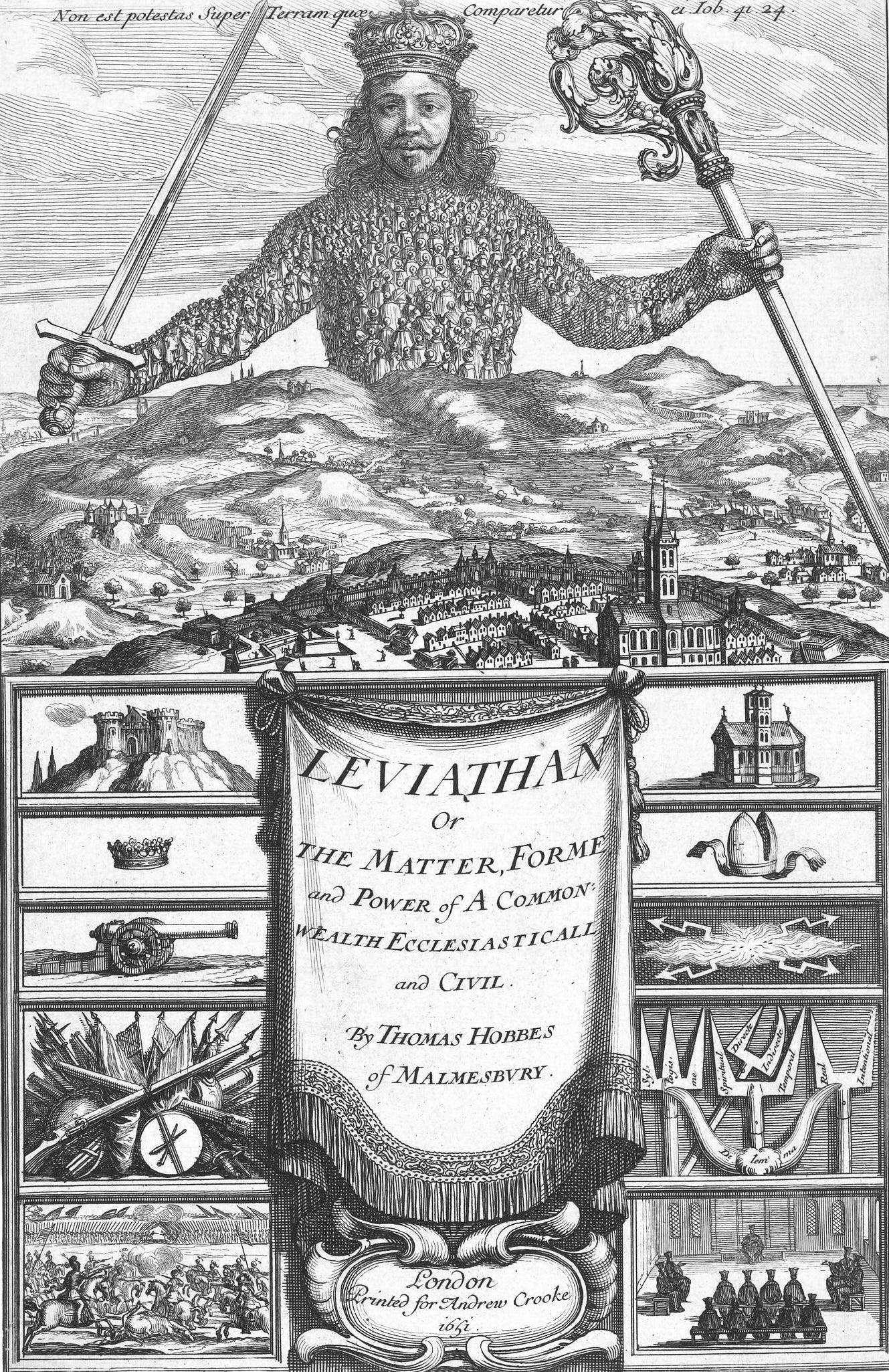
While democracy may be the best we’ve got, and distributing power rather than concentrating it is a worthy aim for our politics, it seems clear from history that democracies can be just as foolish as kingdoms, especially when they take a Leviathan like turn. Because wealth has never been democratized along with the vote, our systems of power have been lopsided, the Leviathan of the democratic state has often been a monster at the bidding of the few.
Historically, then, it seems like we have a king problem. Whether the king sits in power on a throne or vies for it at the voting box, human politics always end up a disappointment. The question, then, is: what do we do about it?
He rode into Jerusalem on an ass, greeted by hallelujahs. God is an improvisor and sometimes a trickster. Recognizing that humans were bound to want a king, God did what all good improvisors do. He agreed with a “yes,” and then changed the terms with a “yes and.” Instead of denying us a king, God sent one. And yet, this king wouldn’t act anything like a typical king. In Jesus, we find a king who subverts the very idea of kingship. Instead of seeking power, he offers service. Instead of claiming the right to use violence, he receives violence without retribution. Instead of building a palace, he lives through the hospitality of others. Instead of amassing wealth for himself and his allies, he lives in poverty and preaches against accumulation. So, when Jesus comes into Jerusalem, he comes as a king, bearing all of Israel’s hope for a king, and yet he does so in an almost complete reversal of what a king is expected to do.
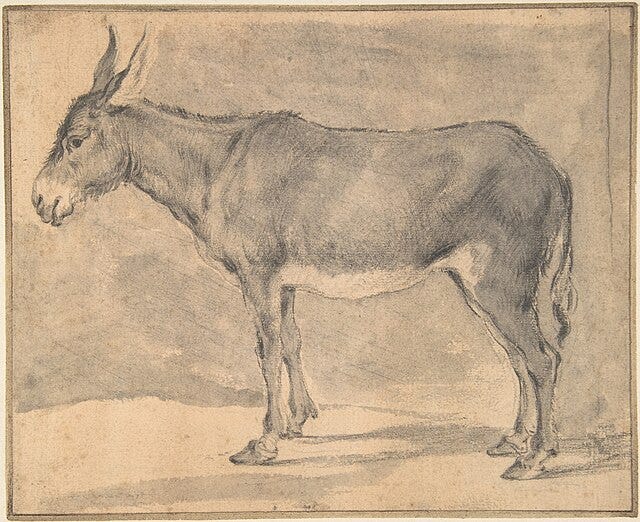
Step back and everything about the scene is a mockery of power. In the so called “Triumphal Entry,” which is itself a title filled with irony, we find Jesus playing out a scene as though he were at a carnival. While Pilot was likely coming into town around the same time in the typical way of a monarch, ready to go to war and crush his opponents on a mighty war horse, Jesus comes riding in on a donkey. If you haven’t seen a donkey lately, think of the character Eeyore from the Whinny the Pooh books. With long ears, a droopy face, and a stubborn demeanor, donkeys are sturdy and tough pack animals, but here is nothing royal about them. And yet, drawing on the prophet Zechariah’s vision of the Messiah, the true king of Israel is to come in riding on just such an animal. It is as though the President paraded into Washington in a ten-year-old Honda Civic—this was an everyday vehicle of the people.
This mockery comes to a culmination in our reading of the Passion with the crown of thorns, the purple robe, the inscription in three languages: The King of the Jews. Here the agents of earthly power try to humiliate the one who has come to subvert their claims to the throne. But as Howard Thurman pointed out, you can’t humiliate the humble. Because of that, all these attempts to mock Jesus, end up as a reversal. What is mocked in the end are those who claim a crown and seek a palace. It is the one who took the way of lowly service whose name is elevated above every name in heaven and on earth.
Yesterday was a day in which many in the United States sought to protest those in power, especially our president, for claims of king-like power. “No Kings in America” was he banner under which they marched. Such a slogan fits with a long tradition in our democracy, and it isn’t a bad one. But of course, we know well, that democracy has never been complete. The monster king of Hobbes’s Leviathan was always ended up a puppet of the few.
The way out of our situation, our scriptures show us, is not with no kings. Instead, we are called to serve a king who came to serve, a king who subverts the very image of the kingship. Instead of one who came to consolidate power, to live in a gilded palace, to gain as much as he could for himself and his loyalists, Jesus came to serve through humble love, even to the point of death. And he calls everyone loyal to his cause, the courtiers of his inner circle, to do the same. Joining our lives with the reign of king Jesus won’t get us rich, it won’t help us gain any kind of power that is recognizable in our politics as usual (and when we do gain such power, we should question our faithfulness). But it will enable us to live into a truth and life that can overcome even the worst kinds of death, a kind of power that lives for mercy and love against all those who claim the power to kill, whether it is for the sake of safety or for greed.
As God’s loyal subjects, let our cry this Palm Sunday and beyond not be “no kings,” but a call to worship the one true king, Jesus, who has come to serve and invite us into the royal call to do the same.